Graphs + Breadth-first search
Breadth-first search allows you to find the shortest distance between 2 values.
Important
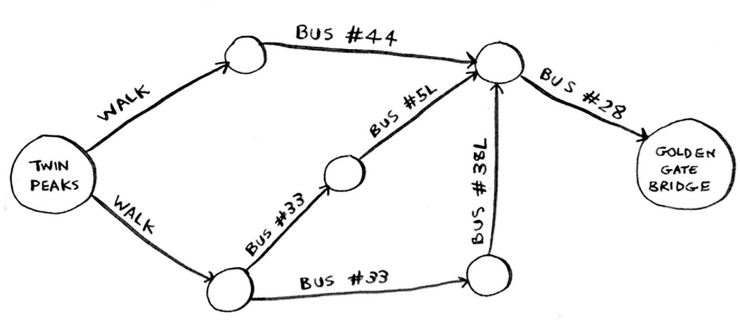
The problem indicated above is known as a shortest-path problem (how can I get from x to y in the fastest way?). The algorithm that we use to solve this? This is breadth-first search.
To figure out how we solve the above diagram in the fastest way, there are 2 main steps:
Model the problem as a graph
Solve the problem using breadth-first search
What even is a graph? A graph is a way to set connections. They’re made up of nodes and edges. A node can be directly connected to other nodes. These nodes that are connected are known as neighbors.
The 2 questions breadth-first answers?
Is there a path from node A to node B?
What is the shortest path from node A to node B?
Linear programming
Linear programming can be used to maximize something given the time constraints.
You’re goal could be: *given 2 meters of fabric + cotton, what’s the maximum amount of shirts and pants that I can make to maximize profit?*
These aren’t direct answers but rather a framework for thinking.
This is quite similar to graph algorithms (actually linear programming is the greater subset for graphs)
Queues
The way we’d organize through different hierarchies (levels) of nodes are through queues. They’re similar to stacks but you can only perform 2 operations: enqueue and dequeue.
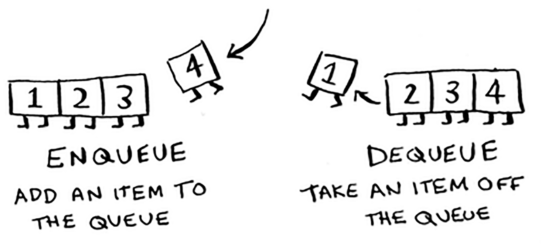
It works in FIFO structure; first in, first out. Notice how as the 4 is added, the 1 is automatically removed.
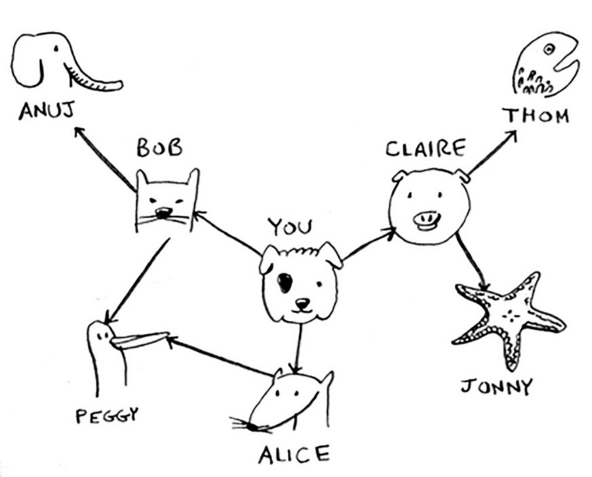
The main concern people face is, How do you express relationships (nodes)? We can do this through hash tables.
For example, with the diagram below:
1graph = {}
2graph[“you”] = [“alice”, “bob”, “claire”]
3graph[“bob”] = [“anuj”, “peggy”]
4graph[“alice”] = [“peggy”]
5graph[“claire”] = [“thom”, “jonny”]
6graph[“anuj”] = []
7graph[“peggy”] = []
8graph[“thom”] = []
9graph[“jonny”] = []
We also have something known as directed graphs. This is essentially when one of the nodes don’t connect to anything else (Anuj, Peggy, Jonny, Thom).
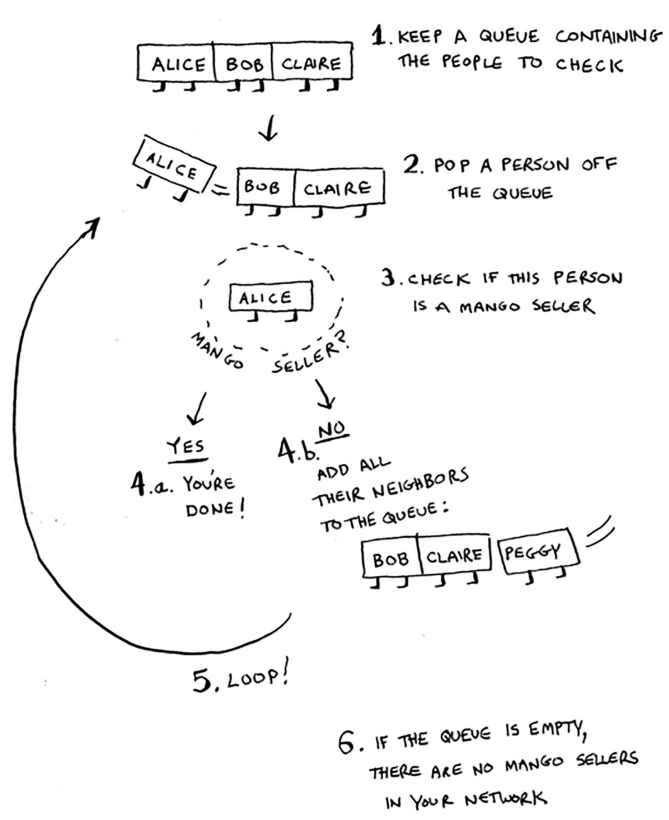
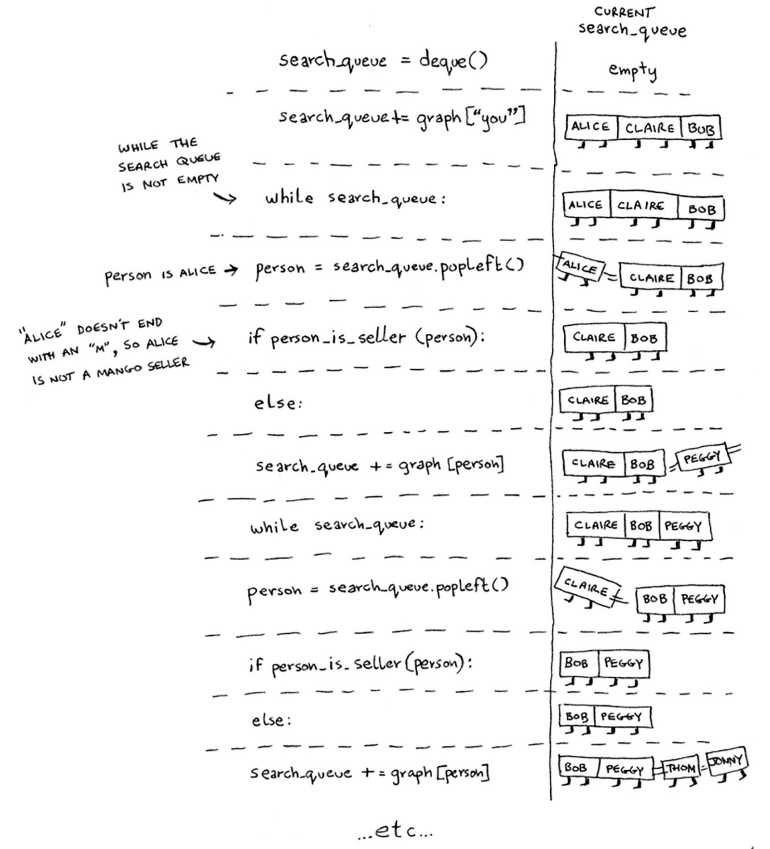
So to recap, here’s what the overall implementation looks like:
 1# A use case of this for "mango" sellers
 2
 3from collections import deque
 4search_queue = deque()
 5search_queue += graph[“you”]
 6
 7def person_is_seller(name):
 8     return name[-1] == ‘m’
 9
10while search_queue:
11     person = search_queue.popleft()
12     if person_is_seller(person):
13             print person + “ is a mango seller!”
14             return True
15     else:
16             search_queue += graph[person]
17return False
 1def search(name):
 2     search_queue = deque()
 3     search_queue += graph[name]
 4     searched = []
 5     while search_queue:
 6             person = search_queue.popleft()
 7             if not person in searched:
 8                     if person_is_seller(person):
 9                             print person + “ is a mango seller!”
10                             return True
11             else:
12                     search_queue += graph[person]
13                     searched.append(person)
14     return False
Note that the running time for this algorithm will be atleast O(n) because we search through and follow each edge.
Important
“Breadth-first search takes O(number of people + number of edges), and it’s more commonly written as O(V+E) (V for number of vertices, E for number of edges).”